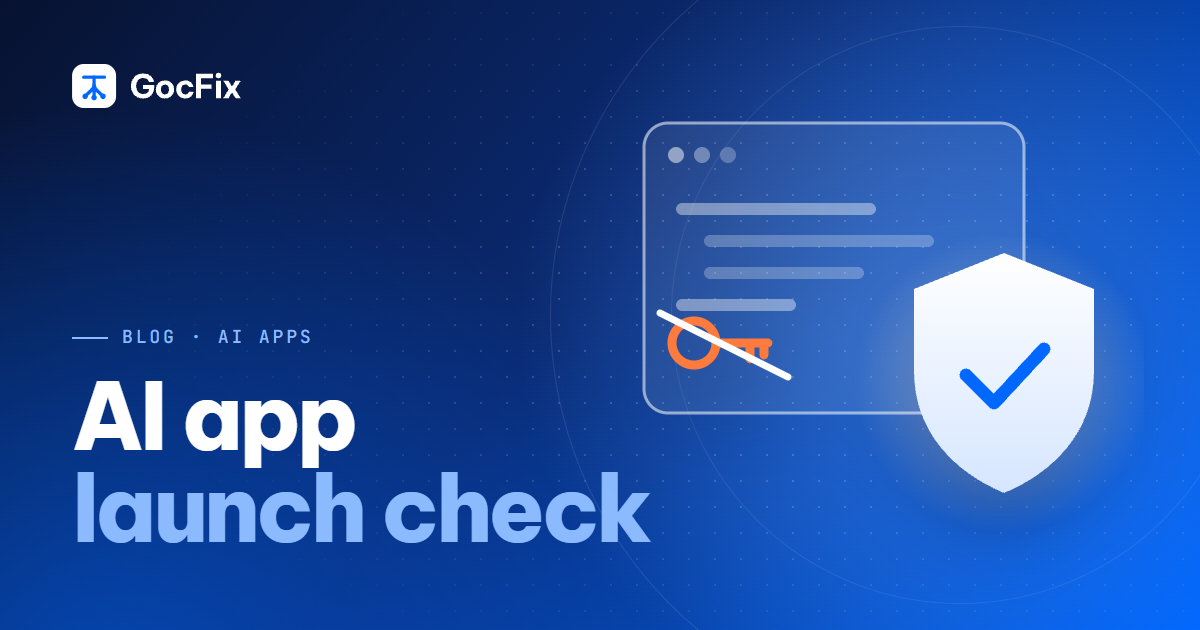
Your AI-built app works. 7 things to check before real customers use it
·3 min read
Cursor, Lovable and Bolt get you an app fast, but AI-written code tends to miss problems that only show up with real users. The 7 things worth checking, and how to check them yourself.
Building a working app with Cursor, Lovable or Bolt in a few days is real. The hard part is the day you open it to real customers. AI-written code is usually right where you can see it (the screens, the main flow) and tends to slip where nobody looks: who can read what, where the keys live, who is allowed to call the API.
These are the 7 things I check first, roughly in order of risk.
1. Database access rules
Supabase and Firebase let the browser read and write the database directly. Whether that is safe depends entirely on the access rules: Supabase's Row Level Security (RLS), or Firebase's Security Rules.
The usual mistake: RLS isn't enabled on one table, or it is, but the policy lets any signed-in user read every row.
Check it yourself: create two accounts. Signed in as A, try to see B's data: change the id in the URL, or replay a request from the browser's Network tab with B's id. If it works, you have a problem.
2. Keys in browser code
Anything in your frontend code can be read by anyone. The "public" Supabase or Firebase key is meant to be there, because the rules in point 1 protect the data. Keys for OpenAI, Stripe, your email service, or Supabase's service_role must never be.
Check it yourself: open the site, press F12 and search the Sources tab for strings like sk-, service_role or secret. If you find one, move it to the server and create a new key right away. Treat the old one as leaked.
3. Permission checks on the server
A "Delete" button that only admins can see doesn't mean only admins can delete. If the API behind it doesn't check permissions itself, anyone who knows the URL can call it.
Check it yourself: for every important action (delete, change a price, change a role, export data), ask: if a normal user called this API directly, would it be refused?
4. Payments
Two common mistakes: trusting the amount the browser sends, and not verifying the payment provider's webhook signature. Either one lets an outsider "pay" whatever they like.
Rule of thumb: prices are always calculated on the server, and an order only becomes "paid" after a webhook with a verified signature.
5. AI model costs
An endpoint that calls OpenAI, Claude or Gemini with no limits is free compute for anyone who finds it. The bill can jump overnight.
Have these: require sign-in before the call, a per-user hourly limit, a cap on input length, and a spending limit set in the provider's dashboard.
6. Backups and restores
Supabase includes backups depending on your plan, but have you ever restored one? One bad delete from the app itself (or from the AI agent you use to edit the code) can wipe a table.
Do this: know where the backups are and how long they're kept, and restore one into a test database at least once.
7. Error logging and alerts
With real users, things break while you're not at your desk. Without error logging, you find out when a customer complains.
Have these: an error tracker (Sentry, or your platform's logs) and an alert when the main page stops responding.
What next
If all 7 look fine, your app is past most of the common risks. If some aren't clear, the fix is usually a few targeted changes, not a rewrite.
I offer an AI-built app review: I read the code, test it with real accounts like an outsider would, and send a report in three priority groups with how to fix each item. You can also start with a free quick scan of what's visible from the outside.
Sound like your system?
A 2–4 day Health Check tells you what to fix first and what can wait.