Automating invoice entry into your accounting software: what works and what doesn't
·2 min read
Before reaching for AI to read photos, look at what form your invoices are in. Vietnamese e-invoices come with an XML file that is far more reliable to read. How to pick the right approach and measure whether it's worth it.
A question I hear a lot from accounting teams: "Can software read our invoices for us? We retype hundreds a month." The answer is usually yes, but how depends heavily on what form your invoices are in.
Step 1: what form are your invoices in?
There are three common forms, and they differ a lot in difficulty:
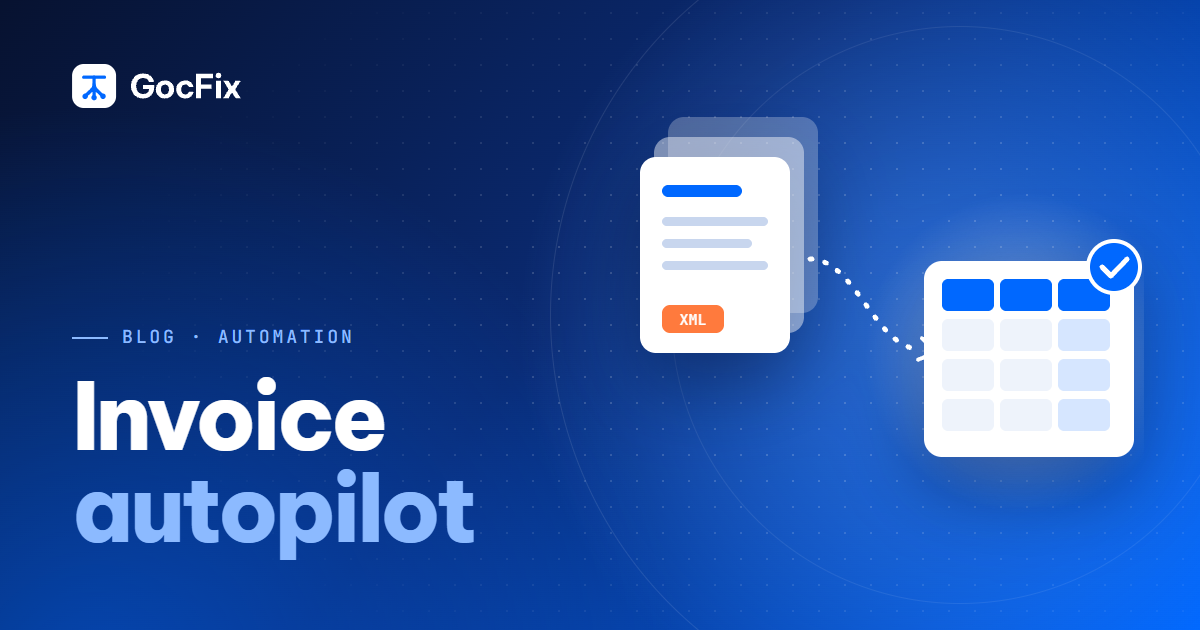
- E-invoices with an XML file. In Vietnam, an e-invoice comes with a viewable PDF and an XML file holding the actual data: tax code, invoice number, every line item, tax rate, totals. Reading the XML is reading structured data, and it is almost never wrong. Automate this kind first.
- "Native" PDFs (exported from software, with selectable text). The text can be extracted directly, but every supplier uses a different layout, so each template needs its own rules.
- Photos and scans. These need OCR or AI to read text from an image. It works, but it is never 100% accurate, especially with blurry or skewed photos or stamps over the text.
Many companies retype from the PDF while the XML file is already sitting in an email or on the invoice provider's lookup portal. Just collecting the right file solves most of the problem.
Step 2: where does the data go?
Reading the invoice is only half the job. The other half is getting the data where it's needed:
- Accounting software with an API: send it straight in.
- No API, but it imports Excel files: generate a file in the import template, and the accountant clicks import.
- Only an internal spreadsheet: write into the right sheet and columns.
The second option sounds old-fashioned, but it is often the safest and fastest: the accountant still controls the final step.
Step 3: a person always checks
Even with XML, there should be a check before anything is booked:
- Is the seller's tax code one of your known suppliers?
- Do the totals match the line items plus tax?
- Has this invoice already been entered (no duplicates)?
With photos, the system should flag the fields it isn't sure about for a person to review, instead of guessing. The goal is for someone to check a few fields, not retype the whole invoice.
Step 4: measure before going big
Before automating, write down a few numbers for one week: invoices per day, time spent, number of mistakes. Pilot one invoice type for 1–2 weeks, then measure again. If the gain is clear, expand. If not, stop, and you've only spent a small amount.
When not to do it yet
- Only a few dozen invoices a month: typing them may still be cheaper.
- The company's invoice approval process isn't clear: automating a messy process just makes the mess faster.
- Invoices are mostly poor-quality phone photos, and suppliers can't send electronic versions.
If you'd like to know whether your invoice process is worth automating, I can look at a few sample invoices and how your accounting team works today. A small first step is possible too: one document type for one team, in 1–2 weeks.
Sound like your system?
A 2–4 day Health Check tells you what to fix first and what can wait.